PSU output rating and electricity use
Does a 750W PSU always use 750W? Rated output versus wall power
A PSU's rated output is not constant electricity use. A transparent 300W example separates component power, efficiency losses and kWh over time.
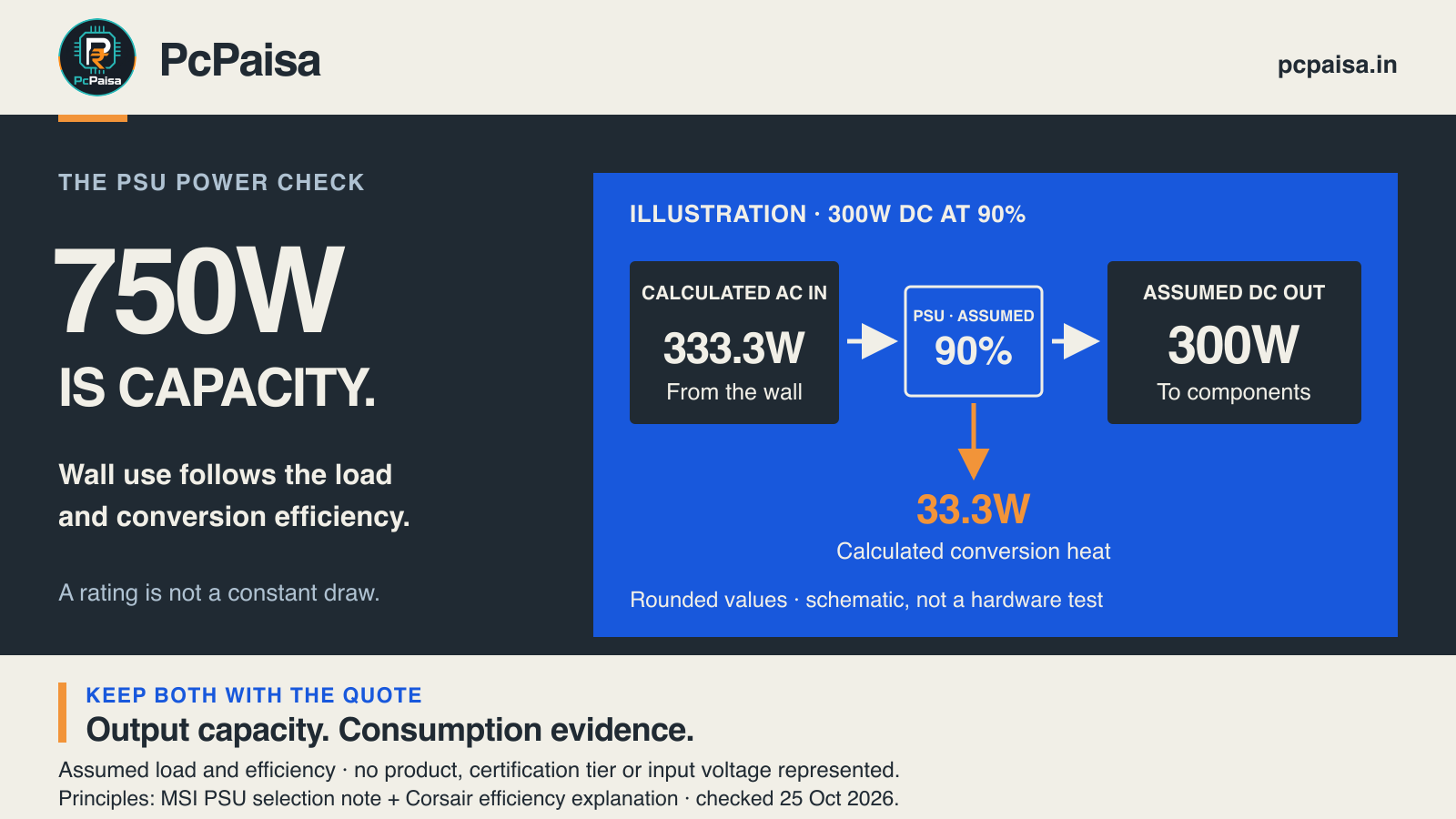
No. A PSU rated for 750W of continuous output does not constantly draw 750W from the wall. Its output rating describes capacity. Actual electricity use depends on the load and the power lost during conversion.
Keep three quantities separate when comparing a PSU or checking a PC quote:
| Quantity | What it tells you |
|---|---|
| Rated DC output, in watts | The PSU’s stated output capacity under its specified conditions |
| Actual AC wall power, in watts | The input power used at that moment, including PSU conversion losses |
| Energy, in kilowatt-hours | Power accumulated over time; this is the quantity needed for an energy-use estimate |
MSI distinguishes continuous rated output from short-duration peak output and advises checking the total rated output on the specification label. This article’s 750W example means a continuous output rating; it is not a claim about an unnamed product’s capabilities. MSI PSU selection note
Why wall power is higher than component power
The PSU converts the wall’s AC power to DC for the PC. Some input power becomes heat during that conversion. Corsair explains that efficiency changes with load, so the same efficiency percentage should not be assumed at every operating point. Corsair: PSU efficiency explained
For a given operating point:
Wall input W = DC output W ÷ efficiency expressed as a decimal.
The conversion loss is wall input minus DC output. Dividing matters: at 90% efficiency, adding 10% to the output is not the same calculation.
A historical r/buildapc question asks whether moving from a 750W to a 1000W PSU always increases electricity use. It is one buyer’s question, not evidence of how common the confusion is. The missing information is the actual load and the efficiency of each candidate at that load.
Reproduce a 300W example
These are PcPaisa calculations using hypothetical inputs, not PSU measurements. Assume the components receive a constant 300W DC, and compare two assumed conversion efficiencies at that same load. Neither row represents a product, an 80 PLUS tier, an input voltage or a typical gaming PC.
| Assumed efficiency at 300W DC | Calculated wall input | Calculated conversion loss | Energy over 4 hours/day × 30 days |
|---|---|---|---|
| 80% | 375W | 75W | 45kWh |
| 90% | About 333.3W | About 33.3W | 40kWh |
The calculation is inspectable:
- 80% row: 300 ÷ 0.80 = 375W at the wall.
- 90% row: 300 ÷ 0.90 = 333⅓W at the wall.
- Energy: wall W × hours ÷ 1,000 = kWh. Here, 4 × 30 = 120 hours.
The 90% row uses 5kWh less over those 120 hours. Energy calculations use the unrounded power values. This is a controlled illustration of efficiency, not an observed saving from buying a larger PSU. Idle, sleep, off-time use, monitors and other devices are outside the example.
To estimate the energy charge, multiply kWh by the applicable per-kWh rate on your own bill. Slabs, fixed charges, taxes and other adjustments need their own treatment. No Indian tariff or future bill is assumed here.
Does a bigger PSU use more electricity?
A higher capacity label alone cannot answer that. At the same component load, two PSUs may have different efficiencies. The strongest reason to question an oversized unit is its efficiency at the loads you actually use, alongside its purchase cost. Conversely, capacity for the build’s peak requirements and planned upgrades can be useful. Neither argument establishes that the biggest or smallest PSU is automatically the best buy.
Do not reduce PSU sizing to an electricity calculation. Required connectors, case fit, documented output limits and the exact component requirements still matter. The manufacturer guide from be quiet! treats connectors, form factor, cooling and protection as separate selection checks. This article uses those stable checks from its dated 2023 guide, not its older model recommendations. be quiet! PSU guide
For an Indian PC purchase or workstation handover, save a short record with the quote:
| Check | What to record |
|---|---|
| Capacity | Exact PSU model, continuous output rating and the build requirements used to select it |
| Fit and connections | Case clearance and required manufacturer-approved connectors/cables |
| Efficiency estimate | Source, load and conditions for any efficiency figure; leave unknown values unknown |
| Actual energy use | A suitable meter’s wall-energy reading, sample dates, workload and which devices were connected |
A reading for the tower plus monitor is a different measurement boundary from the tower alone. Keep that boundary with the result. A short sample also describes only the work performed during that period.
Primary documentation checked on 25 October 2026. No current price, stock, PSU ranking, hardware benchmark, measured energy saving or specific build-compatibility verdict is asserted.
Put your shortlist to work
Catch a price drop on your next PC part.
Follow our Telegram channel for selected Indian PC-part price-drop alerts from PcPaisa’s tracked price history.
Join Telegram deal alerts