SSD write endurance and warranty limits
Does 600 TBW mean an SSD lasts five years? Read both warranty limits
Samsung's 990 PRO 1TB lists five years or 600 TBW, whichever comes first. Two explicit write-workload calculations show why both limits matter.
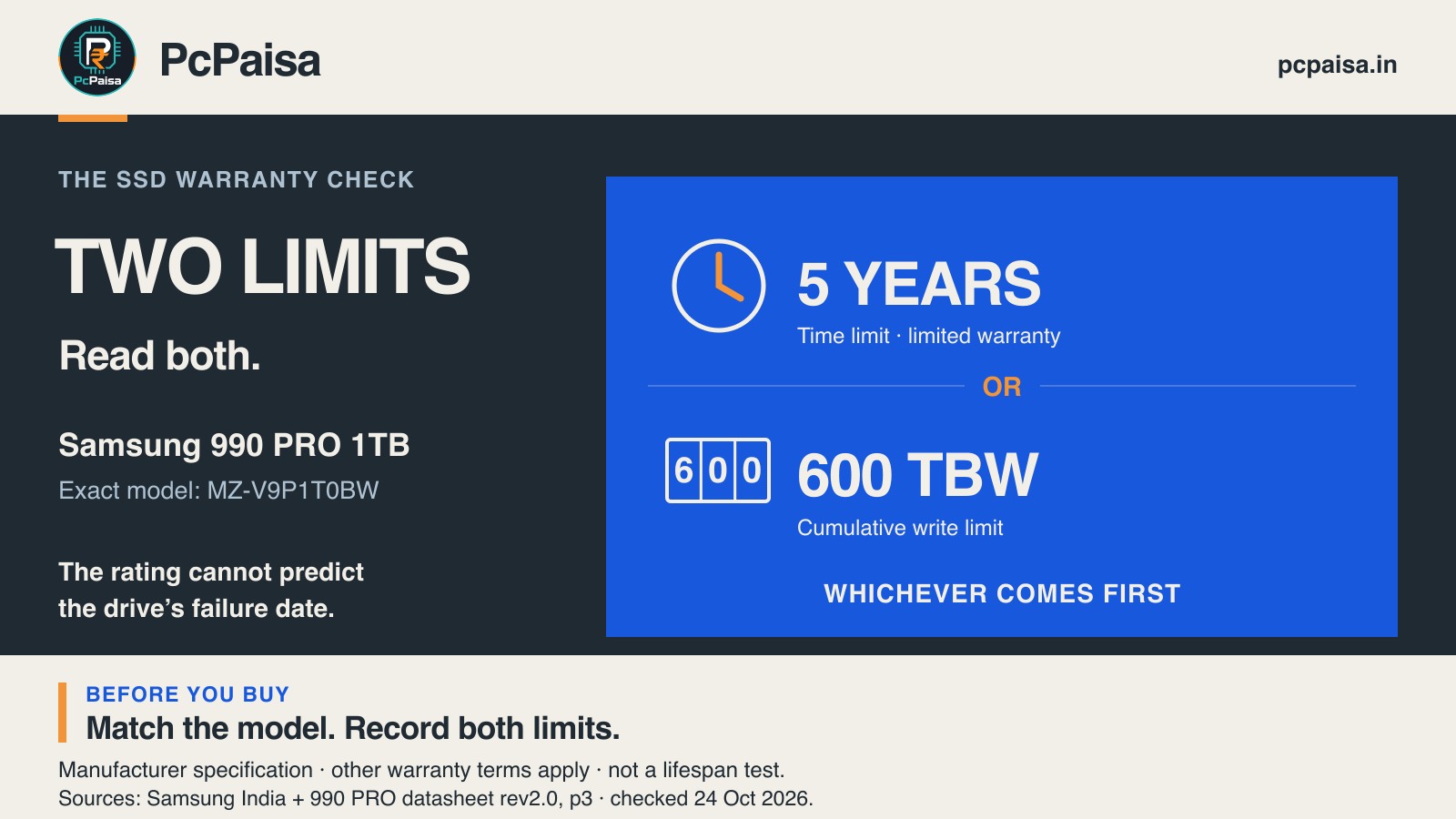
No. A TBW rating does not give an SSD a predictable failure date. When comparing drives, read the write limit alongside the warranty’s time limit, then check the complete terms for the exact product.
For a concrete example, Samsung India’s 990 PRO 1TB, model MZ-V9P1T0BW, lists a five-year limited warranty or 600 TBW. Samsung’s 990 PRO datasheet explains that the earlier limit applies. This article uses that specific 1TB model; do not copy its write allowance to another capacity or SSD family. Samsung India specifications, 990 PRO datasheet, revision 2.0, pages 3–4
What does 600 TBW tell you?
TBW means terabytes written. Here, it is a cumulative write allowance in the manufacturer’s warranty specification. It is separate from the drive’s storage capacity and from its transfer speed.
Samsung’s global SSD warranty page repeats the time-or-write rule. These limits do not establish that every failure below 600 TBW is covered: the agreement also has conditions and exclusions. Samsung SSD warranty
A historical r/buildapc question captures the buying dilemma: a first-time builder asked whether to prioritise the largest TBW figure to avoid a drive failure. That is one person’s question, not a survey of users or a reliability test. The useful distinction is between a published allowance and an observed failure rate. The sources here establish the former.
Compare two hypothetical workloads
The following is PcPaisa arithmetic, not measured usage or a lifespan test. Assume a new drive starts at zero cumulative writes, writes the same amount every day, and uses decimal units: 1 TB = 1,000 GB. For this illustration, five years means 5 × 365 = 1,825 days; an actual warranty follows its applicable calendar dates and terms.
| Assumed writes per day | Projected writes over 1,825 days | Which numerical limit comes first? |
|---|---|---|
| 100 GB/day | 182.5 TB | Five-year time limit; projected writes remain below 600 TB |
| 500 GB/day | 912.5 TB | 600 TB write threshold, reached after 1,200 days, about 3.3 years |
You can reproduce the table:
- Five-year writes: daily GB × 1,825 ÷ 1,000 = TB.
- Days to 600 TB: 600 × 1,000 ÷ daily GB.
At 500 GB/day, that second calculation is 600,000 ÷ 500 = 1,200 days. It identifies when the example reaches the stated threshold; subsequent writes exceed it. It does not predict that the drive will stop working then.
Neither assumed workload is presented as typical of gaming, video editing or office use. Nor does being below the write threshold guarantee that a drive will remain functional until year five.
Should you buy the SSD with the highest TBW?
The strongest case for a larger write allowance is a workload whose observed writes could reach the smaller allowance during the intended service period. In that situation, TBW deserves attention.
But that conclusion needs your workload, not an occupation label. If a drive tool exposes a cumulative bytes-written counter, record it at two points across representative working days. Divide the increase by elapsed days, keeping the units consistent. A short sample is an estimate; repeat it when the workload changes. The space occupied by your current files is not that cumulative counter.
For an Indian purchase or workstation quote, keep a small decision record:
| Record | Why it helps |
|---|---|
| Full model code and capacity | Prevents borrowing another variant’s specification |
| Time limit and TBW allowance | Makes both numerical limits visible |
| Observed writes and sample dates | Replaces a guessed daily workload with a bounded estimate |
| Purchase documents and applicable regional terms | Keeps the service-eligibility question separate from the arithmetic |
The India product page is the local specification anchor here. The global warranty page explains the general rule; this article has not established eligibility for a particular invoice, imported unit or service claim. Samsung’s service FAQ says its service centre checks the serial number, model and condition before determining validity and covered issues. Samsung service and warranty FAQ
Use TBW to compare a documented write allowance with your workload. Keep backups as a separate requirement: the warranty calculation cannot tell you when your files might become unavailable.
Primary documentation checked on 24 October 2026. No current price, stock, hardware benchmark, failure-rate measurement or individual warranty decision is asserted.
Put your shortlist to work
Catch a price drop on your next PC part.
Follow our Telegram channel for selected Indian PC-part price-drop alerts from PcPaisa’s tracked price history.
Join Telegram deal alerts