UPS apparent power, real power and backup duration
Is a 1100VA UPS enough for your PC? Check watts and runtime
A 1100VA label does not mean 1100W or a fixed backup time. Use APC’s BX1100C-IN ratings to check both capacity limits, then runtime at your load.
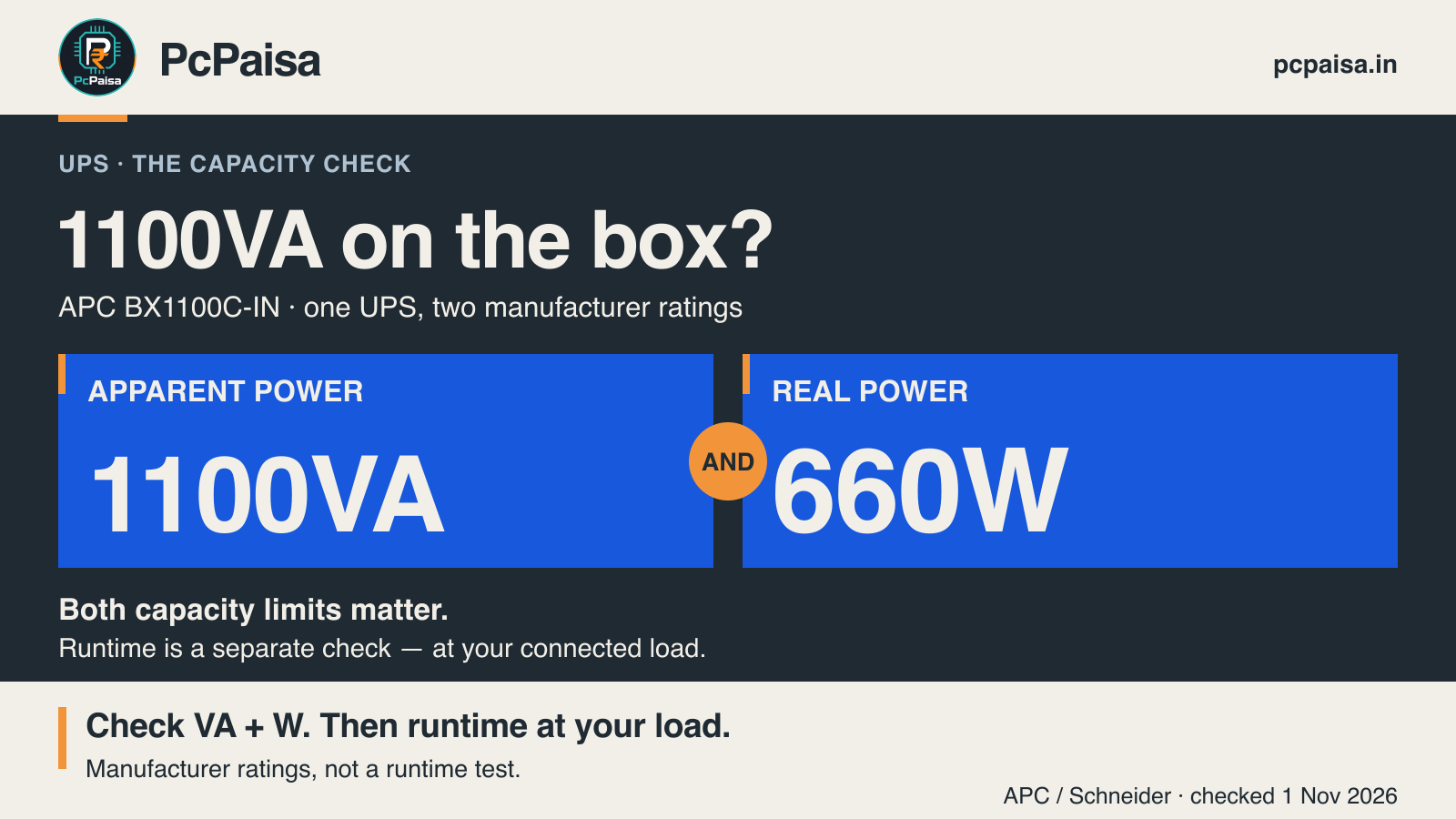
A 1100VA UPS is not necessarily a 1100W UPS, and the VA number does not tell you how many minutes your PC will keep running. Check the exact model’s watt limit as well as its VA limit, then look for runtime evidence at the load you intend to connect.
A concrete Indian-market example is the APC Back-UPS BX1100C-IN. Schneider Electric’s official India product page lists 1100VA and 660W. These are manufacturer specifications, not PcPaisa output measurements or a recommendation for an unspecified gaming PC.
One UPS, two capacity limits
| Exact model | Apparent-power rating | Real-power rating |
|---|---|---|
| APC BX1100C-IN | 1100VA | 660W |
Watts (W) describe real power. Volt-amperes (VA) describe apparent power. Schneider Electric’s explanation of the two units states that attached equipment must exceed neither the UPS watt limit nor its VA limit.
That means a purchase check needs two comparisons, in matching units: load watts against UPS watts, and load VA against UPS VA. Do not treat 1100VA as permission to attach a 1100W load to this 660W-rated example. Do not turn this model’s rating pair into a fixed conversion for every UPS either.
Here is why checking only one number can miss a problem:
| Illustrative attached load—not a measured PC | Check against this model’s published ratings |
|---|---|
| 700W and 800VA | 800VA is below 1100VA, but 700W exceeds 660W. The watt check fails. |
| 600W and 1200VA | 600W is below 660W, but 1200VA exceeds 1100VA. The VA check fails. |
These are arithmetic examples showing two independent limits. They are not typical PC consumption figures, hardware tests or permission to operate close to either maximum. If you have watts but no VA or relevant load power-factor evidence, the second check is still missing. Eaton’s VA-versus-watts guide explains the relationship.
Capacity does not promise backup minutes
Capacity answers whether a UPS can support a load within its documented operating limits. Runtime answers how long it can support a particular load. A label such as 1100VA or 660W is a power rating, not a stored-energy figure or a duration.
Eaton’s UPS sizing guide treats load capacity and required runtime separately. Schneider’s sizing guidance also says to check each unit’s own runtime graph and leave capacity headroom for peaks and expansion.
For a purchase, ask for the exact UPS model’s runtime curve or selector result at your intended connected load, with its stated conditions. A quoted backup time without a load is incomplete evidence. We have not established a BX1100C-IN runtime point for a particular PC, so this article does not promise a number of minutes.
“I only need time to save and shut down”
That is a useful runtime objective. It does not remove the capacity check: the UPS still has to support the equipment during that interval.
List the devices you need to keep running—perhaps the PC and monitor, with networking equipment if the task needs it. Use their relevant combined AC load rather than the PSU’s output-capacity label. A PSU marked 750W is not evidence that the PC is drawing 750W from the socket; our PSU rating versus wall-power explanation covers that distinction.
This article checks the meaning of the ratings. Waveform, transfer-time behaviour, outlets and software support still need their own exact-model checks; matching the two capacity numbers alone is not full compatibility approval.
Put three fields on the quote
For a PC build or office workstation quotation, ask the supplier to record:
- Exact UPS model and both output ratings: VA and W, with the manufacturer source.
- Connected equipment and load evidence: what is included, the workload considered, and the W/VA information used for sizing.
- Required shutdown interval and supporting runtime evidence: the model’s estimate at that load, plus any conditions and remaining checks.
This makes the selection inspectable. If the quote supplies only “1100VA UPS”, the watt limit and runtime evidence still need to be filled in. Choose the UPS after those checks, rather than inferring a complete fit from the largest number on the box.
Primary sources checked 1 November 2026. No current selling price, stock, UPS runtime test or exact PC configuration is claimed.
Put your shortlist to work
Catch a price drop on your next PC part.
Follow our Telegram channel for selected Indian PC-part price-drop alerts from PcPaisa’s tracked price history.
Join Telegram deal alerts